
RESEARCH / 02

Electrocatalysis & Energy Materials

Understanding electrochemical reactions through atomic-scale modeling

An electrode’s working surface depends on its environment. Potential, solution conditions and adsorbed species influence both the material present and the reactions it can support. My collaborative research connects electronic structure and surface thermodynamics with questions in electrochemical energy conversion.

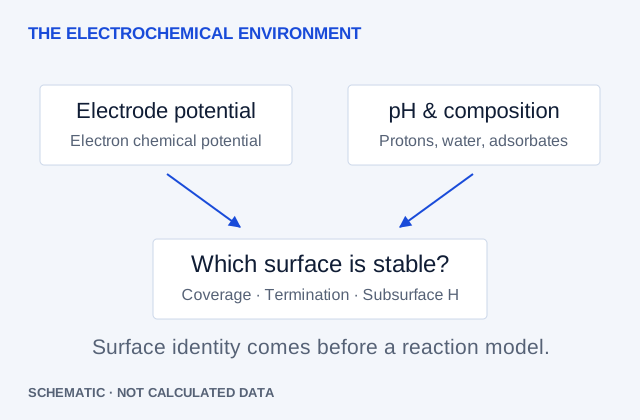
Conceptual workflow linking electrode potential and solution chemistry to surface-state stability.
Potential and chemical conditions help determine plausible surface states. Conceptual illustration, not a calculated Pourbaix diagram.

FUNDAMENTAL QUESTIONS

Start with the physical question.

  • Which surface is actually present?

    A clean crystal is a useful reference, but oxygen-containing adsorbates or subsurface hydrogen can change the surface under electrochemical conditions.

  • What does potential change?

    Electrode potential changes the free-energy balance of electron-transfer steps; pH and chemical composition also influence surface stability.

  • How does structure affect chemistry?

    Local coordination, defects and catalyst architecture change adsorption environments. Calculations help interpret their role alongside experimental measurements.

RESEARCH DIRECTIONS

The interface sets the context.

Hydrogen: adsorption, architecture and storage

Hydrogen-related electrocatalysis connects several scales: the binding of H at individual sites, the arrangement of catalytic metals on a support, and—in palladium—the incorporation of hydrogen beneath the surface. These are related but distinct questions.

The PtRu/carbon-nanotube collaboration combines catalyst synthesis and electrochemical measurements with DFT interpretation. The palladium studies instead use surface and interface thermodynamics to investigate potential-dependent hydride formation and defect stability.

PtRu hydrogen evolution · Pd hydride formation

Oxygen evolution: begin with the surface state

The IrO2(110) work asks which oxygen-rich terminations are plausible under electrochemical conditions before considering a reaction cycle. Surface Pourbaix analysis and reaction free energies connect the stability of adsorbates with the thermodynamic requirements of oxygen evolution.

Thermodynamically favored structures are candidates for mechanistic analysis. Establishing an operative pathway and its rate requires additional kinetic and experimental evidence.

IrO₂ surface-composition study

FEATURED INVESTIGATIONS

Evidence at the atomic scale.

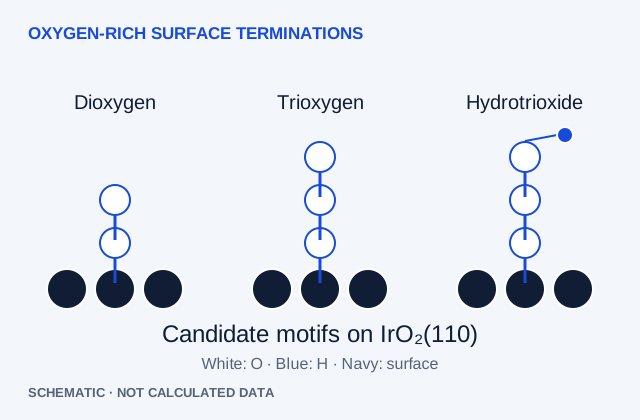
Simplified dioxygen, trioxygen and hydrotrioxide motifs above an iridium oxide surface.
Candidate oxygen-rich motifs, drawn schematically. No numerical phase boundaries or relaxed atomic coordinates are shown.
OXYGEN EVOLUTION · IrO₂(110)

The surface state changes the mechanistic question

Scientific question
How do oxygen-rich terminations affect a plausible oxygen-evolution cycle?
Approach
First-principles structures, surface Pourbaix diagrams and electrochemical free-energy analysis.
Principal finding
The study identifies stable di-/trioxygen terminations and proposes a hydrotrioxide-involving cycle in which water dissociation regenerates the termination and sets the calculated potential requirement.
Why it matters
Surface composition changes the thermodynamic pathway under discussion. A potential-limiting step is not, by itself, a kinetically rate-limiting step.
ACS Omega 11, 4692–4698 (2026) ↗
Full reference

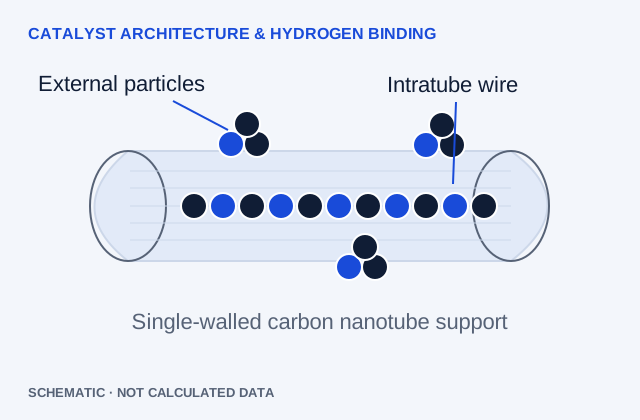
Schematic carbon nanotube containing a PtRu wire with additional particles on its exterior.
Conceptual intratube wire and external particles. This is not microscopy or a specific calculated structure.
HYDROGEN EVOLUTION · PtRu / SWNT

Connecting catalyst architecture with hydrogen binding

Scientific question
How can intratube and surface PtRu architectures support alkaline hydrogen evolution?
Approach
A collaborative experimental study with DFT analysis of hydrogen binding on supported catalyst structures.
Principal finding
The collaboration reports active PtRu/SWNT catalysts and electrolyser performance; calculations rationalize the behavior through near-optimal hydrogen binding.
Why it matters
Experiment establishes performance, while DFT helps interpret local interactions. Both contributions are needed to connect architecture with activity.

Applied Catalysis B: Environmental 315, 121541 (2022) ↗
Full reference

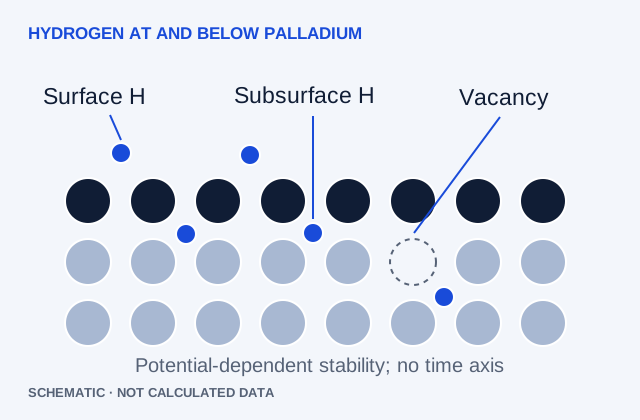
Conceptual palladium slab containing surface hydrogen, subsurface hydrogen and a vacancy.
Ingredients of a surface thermodynamic model. No time-dependent restructuring or phase-switching trajectory is implied.
SURFACE & SUBSURFACE HYDROGEN · Pd

Palladium as a potential-dependent hydrogen host

Scientific question
How do hydrogen incorporation and defects affect palladium surface stability?
Approach
DFT-based surface Pourbaix diagrams compare hydrogen coverages, hydride layers and defective low-index surfaces.
Principal finding
The calculations connect lower potentials with increased hydrogen incorporation and show that hydrogen sublayers can stabilize defective surfaces.
Why it matters
They show why a pristine, hydrogen-free surface can miss relevant catalyst states. These are thermodynamic predictions, not measured restructuring rates.

International Journal of Hydrogen Energy 61, 460–472 (2024) ↗
Full reference

FUEL-CELL REACTION CHEMISTRY

Borohydride electro-oxidation

Borohydride oxidation brings adsorption, dehydrogenation and oxygen-containing surface reactions into the same electrochemical problem. The Au–3d alloy studies connect changes in electronic structure with the energetics and potential requirements of the oxidation sequence.

Calculations for Au3Ni(111) examine both electrochemical free energies and a dehydrogenation barrier. The broader Au3M comparison shows how alloy composition changes the calculated thermodynamic demands relative to gold.

A bridge from composition to reactivity

These studies support an approach that asks how a changed atomic environment alters adsorption and elementary steps. They do not independently establish a device efficiency or replace a complete kinetic description.

Au–3d alloy comparison · Au₃Ni mechanism

METHODS & SCIENTIFIC APPROACH

From a model to an interpretation.

  1. Define electrochemical conditionsSpecify the potential, pH and chemical reservoirs represented by the model.
  2. Compare surface statesEvaluate adsorbates, terminations, defects or hydrogen-containing layers.
  3. Assess stabilityUse surface thermodynamics to identify plausible states under those conditions.
  4. Examine reaction free energiesCompare elementary electrochemical steps on selected surfaces.
  5. Separate thermodynamics from kineticsDo not equate a potential requirement with a reaction rate.
  6. Connect with measurementsUse experiments to test material behavior and constrain interpretation.

EMERGING QUESTIONS

From a stable surface to a working interface

Open questions concern potential-dependent active sites, changes in surface composition and the relationship between restructuring and reactivity. Connecting thermodynamic surface-state predictions with kinetic evidence is a research direction, rather than a claim that a complete operating mechanism has already been established.

SELECTED PUBLICATIONS

The work behind the questions.

  1. 2026
    Electrochemical Surface Composition of Iridium Oxide IrO₂(110): Implications for the Oxygen Evolution Reaction Mechanism ↗

    Ryan Lacdao Arevalo; Jessiel Siaron Gueriba; Hiroshi Nakanishi

    ACS Omega 11, 4692–4698 (2026). DOI: 10.1021/acsomega.5c10410

  2. 2022
    Hydrogen evolution in alkaline medium on intratube and surface decorated PtRu catalyst ↗

    Farhan S. M. Ali; Ryan Lacdao Arevalo; Matthias Vandichel; Florian Speck; Eeva-Leena Rautama; Hua Jiang; Olli Sorsa; Kimmo Mustonen; Serhiy Cherevko; Tanja Kallio

    Applied Catalysis B: Environmental 315, 121541 (2022). DOI: 10.1016/j.apcatb.2022.121541

  3. 2024
    Computational surface Pourbaix diagrams to unravel cathodic hydride formation on defective palladium surfaces ↗

    Raju Lipin; Apinya Ngoipala; Ryan Lacdao Arevalo; Matthias Vandichel

    International Journal of Hydrogen Energy 61, 460–472 (2024). DOI: 10.1016/j.ijhydene.2024.02.248

  4. 2024
    Computational unravelling of cathodic hydride formation on palladium surfaces ↗

    Apinya Ngoipala; Raju Lipin; Ryan Lacdao Arevalo; Matthias Vandichel

    International Journal of Hydrogen Energy 53, 829–839 (2024). DOI: 10.1016/j.ijhydene.2023.12.019

  5. 2013
    Mechanistic Insight into the Au-3d Metal Alloy-Catalyzed Borohydride Electro-Oxidation: From Electronic Properties to Thermodynamics ↗

    Ryan Lacdao Arevalo; Mary Clare Sison Escaño; Hideaki Kasai

    ACS Catalysis 3, 3031–3040 (2013). DOI: 10.1021/cs400735h

  6. 2013
    Computational Mechanistic Study of Borohydride Electrochemical Oxidation on Au₃Ni(111) ↗

    Ryan Lacdao Arevalo; Mary Clare Sison Escaño; Hideaki Kasai

    The Journal of Physical Chemistry C 117, 3818–3825 (2013). DOI: 10.1021/jp311904k

View the complete Publications section →

RESEARCH COLLABORATIONS

Connect around a scientific question.

I welcome collaborations linking electrochemical measurements and materials characterization with calculations of adsorption, surface stability and elementary reaction chemistry.

Discuss a collaboration →