
RESEARCH / 01

Heterogeneous Catalysis

Understanding chemical reactions at surfaces from first principles

A catalyst offers more than a place for molecules to meet. Its atomic structure determines how they bind, which bonds can break, and where a reaction can go next. My work with collaborators uses first-principles calculations to connect this local chemistry with mechanisms, selectivity, and catalyst-design questions.

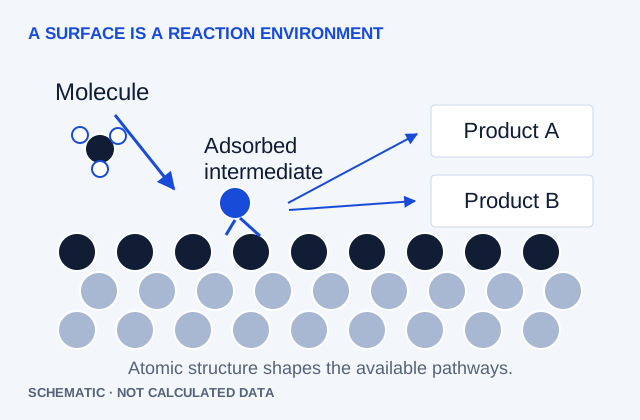
Conceptual molecule-to-surface pathway branching toward two possible products.
Surface structure opens competing reaction pathways. Schematic illustration; atomic positions and arrows are not calculated structures or rates.

FUNDAMENTAL QUESTIONS

Start with the physical question.

  • What activates a stable molecule?

    Adsorption and bond cleavage depend on the local arrangement of atoms. Steps, alloying and subsurface atoms provide different chemical environments.

  • Why does a pathway win?

    An accessible elementary step need not carry most of the reaction flux. Competing routes, occupied sites and reversible chemistry influence the outcome.

  • What keeps a site available?

    Strongly bound carbon or sulfur-containing species can obstruct reactive sites. Catalyst design must consider what accumulates as well as what reacts.

RESEARCH DIRECTIONS

Molecules, sites and competing pathways.

Methane: activation is only the beginning

Breaking a methane C–H bond starts a sequence of surface reactions. The subsequent behavior of CHx fragments and adsorbed carbon is central to the balance between conversion and site occupation. Work on stepped nickel examines how atoms below the exposed layer change carbon binding; studies of ruthenium reforming ask how carbon can be converted into oxygen-containing species.

On oxide catalysts, a different challenge arises: species from the feed can alter the sites needed for methane activation. The PdO(101) sulfation study connects sulfur chemistry with site blocking through atomistic calculations.

Subsurface Ni design · Ru reforming · PdO sulfation

Syngas: building a carbon chain

Producing higher alcohols from CO and H2 requires carbon–carbon bond formation while retaining an oxygen-containing pathway. The Rh(211) program examines CO activation, hydrogenation, CO/CHO insertion and the competition between oxygenated intermediates.

The 2024 mechanism study maps elementary reactions. The 2025 alloy study explores changes in CO chemistry after transition-metal substitution. The subsequent microkinetic preprint asks how the elementary reactions on Rh(211) operate together at steady state.

Rh reaction mechanisms · Alloy effects · Microkinetic preprint

FEATURED INVESTIGATIONS

Evidence at the atomic scale.

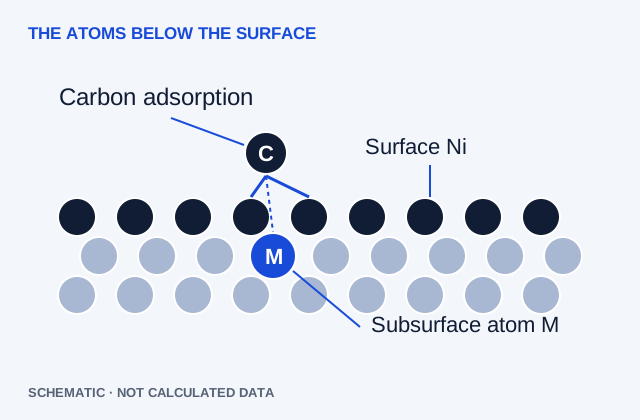
Schematic carbon adsorbate above a metal slab with a highlighted subsurface substitution.
A subsurface atom is a catalyst-design variable. This schematic does not reproduce a relaxed geometry.
METHANE ACTIVATION · Ni(211)

The influence of atoms beneath a surface

Scientific question
Can subsurface substitution change carbon binding on stepped nickel?
Approach
Periodic DFT calculations compare adsorption, reaction energetics and electronic structure.
Principal finding
The study links carbon stabilization to surface and subsurface bonding, and predicts that selected substitutions weaken carbon binding.
Why it matters
It identifies an atomic route for changing methane-decomposition chemistry. Practical resistance to carbon accumulation still requires validation.
Scientific Reports 7, 13963 (2017) ↗
Full reference

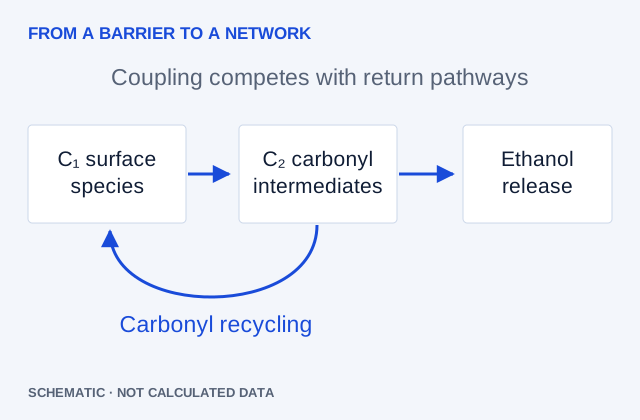
Qualitative network connecting C1 species, C2 carbonyl intermediates and ethanol, with a recycling pathway.
Network connectivity, not measured flux. Arrow widths do not represent calculated reaction rates.
SYNGAS CONVERSION · Rh(211)Preprint

Why a C–C bond is not the whole story

Scientific question
Does favorable carbon coupling necessarily lead to productive ethanol formation?
Approach
A thermodynamically consistent mean-field microkinetic model, with flux and degree-of-rate-control analyses.
Principal finding
The preprint predicts carbonyl recycling back to the C₁ pool that limits productive ethanol formation.
Why it matters
The result shifts attention to downstream conversion and the full reaction network when interpreting selectivity.

ChemRxiv, version 1 (2026) · Preprint ↗
Full reference

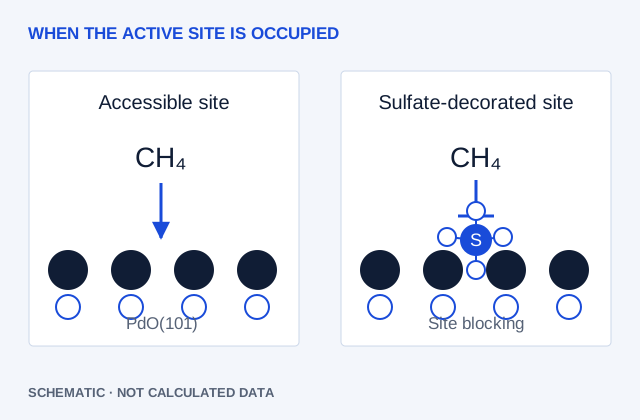
Conceptual comparison of an accessible palladium oxide site and a sulfate-decorated site.
Schematic site occupation. The sulfate symbol is not a computed adsorption configuration.
METHANE OXIDATION · PdO(101)

Following the chemistry of site blocking

Scientific question
How can sulfur-containing species interfere with methane activation on PdO?
Approach
First-principles calculations examine SO₂ oxidation, sulfate formation and methane activation pathways.
Principal finding
The calculations predict sulfate-decorated surfaces that block coordinatively unsaturated Pd sites under oxygen-rich conditions.
Why it matters
A molecular account of poisoning helps frame design questions for sulfur-tolerant catalysts; it is not an experimental durability demonstration.

Catalysis Science & Technology 9, 232–240 (2019) ↗
Full reference

METHODS & SCIENTIFIC APPROACH

From a model to an interpretation.

  1. Atomic surface structureChoose the facet, step, composition and relevant adsorbates.
  2. Adsorption energeticsCompare stable configurations and molecule–surface interactions.
  3. Transition statesLocate barriers connecting elementary reaction states.
  4. Reaction networkConnect chemically consistent pathways and site balances.
  5. Microkinetic analysisPredict coverages, rates and pathway flux where a kinetic model is available.
  6. Catalytic interpretationTranslate model trends into hypotheses that experiments can test.

EMERGING QUESTIONS

Questions beyond a single surface snapshot

How do changing surface populations redirect chemistry? Which steps preserve oxygenated intermediates rather than recycle them? How robust are design trends to coverage and model assumptions? These are prospective research questions connecting surface evolution, selectivity control and first-principles kinetic modeling—not claims of demonstrated improvements.

SELECTED PUBLICATIONS

The work behind the questions.

  1. 2026
    Carbonyl Recycling Limits Productive Ethanol Formation during Syngas Conversion on Rh(211): A First-Principles Microkinetic Analysis ↗Preprint · not peer reviewed

    Ryan Lacdao Arevalo; Hiroshi Nakanishi

    ChemRxiv, version 1 (2026). DOI: 10.26434/chemrxiv.15008804/v1

  2. 2025
    Effect of alloying in carbon monoxide reactions on a stepped rhodium surface ↗

    Ryan Lacdao Arevalo; Hiroshi Nakanishi

    Japanese Journal of Applied Physics 64, 055503 (2025). DOI: 10.35848/1347-4065/adcc6f

  3. 2024
    A First Principles Mechanistic Study of Higher Alcohol Synthesis from Syngas on a Stepped Rhodium Surface ↗

    Ryan Lacdao Arevalo; Hiroshi Nakanishi

    Catalysis Letters 154, 3418–3425 (2024). DOI: 10.1007/s10562-023-04565-y

  4. 2019
    Sulfation of a PdO(101) methane oxidation catalyst: mechanism revealed by first principles calculations ↗

    Ryan Lacdao Arevalo; Susan Meñez Aspera; Hiroshi Nakanishi

    Catalysis Science & Technology 9, 232–240 (2019). DOI: 10.1039/C8CY02096E

  5. 2017
    Tuning methane decomposition on stepped Ni surface: The role of subsurface atoms in catalyst design ↗

    Ryan Lacdao Arevalo; Susan Meñez Aspera; Mary Clare Sison Escaño; Hiroshi Nakanishi; Hideaki Kasai

    Scientific Reports 7, 13963 (2017). DOI: 10.1038/s41598-017-14050-3

  6. 2017
    Ru-Catalyzed Steam Methane Reforming: Mechanistic Study from First Principles Calculations ↗

    Ryan Lacdao Arevalo; Susan Meñez Aspera; Mary Clare Sison Escaño; Hiroshi Nakanishi; Hideaki Kasai

    ACS Omega 2, 1295–1301 (2017). DOI: 10.1021/acsomega.6b00462

View the complete Publications section →

RESEARCH COLLABORATIONS

Connect around a scientific question.

I welcome conversations about surface reaction mechanisms, methane and syngas chemistry, and combining atomistic calculations with experimental catalyst studies.

Discuss a collaboration →