
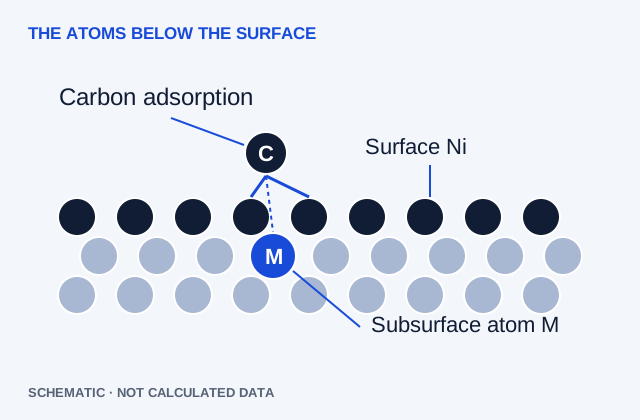
Methane activation
Comparing adsorption and electronic structure reveals how subsurface composition changes the environment of carbon on nickel.
Explore surface catalysis →RESEARCH / 03
Connecting electronic structure, atomic-scale mechanisms, and materials behavior
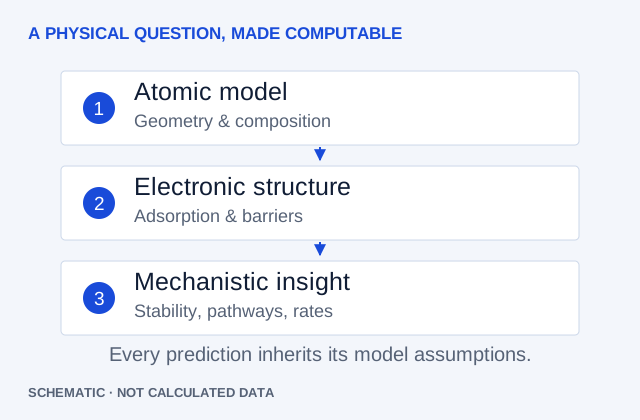
A useful calculation begins with a physical question and a model that can answer it. My research uses quantum-mechanical descriptions of surfaces and reactions to examine how atomic structure influences materials behavior—and to turn that understanding into hypotheses that can be tested with experiments.
FUNDAMENTAL QUESTIONS
Choose structures, chemical environments and observables that address the scientific question, while keeping the approximation explicit.
An electronic energy, a free energy and a reaction rate answer different questions. Their connection requires additional physical assumptions.
Check numerical consistency and chemical plausibility, compare alternatives, and distinguish model interpretation from experimental validation.
MODELS & APPROXIMATIONS
DFT provides a practical route to electronic structure and total energies. In my surface-chemistry work, optimized structures and energy differences help describe adsorption, bond activation and the effects of catalyst composition. Electronic-structure analysis helps interpret why an interaction changes.
The published record includes periodic plane-wave DFT calculations with VASP. Functional choice, dispersion treatment and numerical settings belong to each study’s methodology; no single setup is assumed to describe every material or chemical environment.
Electronic structure and subsurface design · Rh(211) reaction calculations
Periodic slabs represent a chosen crystal surface with a finite number of atomic layers. Steps, alloy substitutions, subsurface atoms and adsorbates introduce specific local environments. Comparing such models can expose structure–reactivity relationships that a single ideal surface would conceal.
For electrochemical questions, surface thermodynamics adds chemical and electrical conditions to the comparison. The model’s coverage, composition and treatment of the environment remain part of the interpretation.
Defective palladium surfaces · Electrochemical surface composition
ELEMENTARY REACTION MECHANISMS
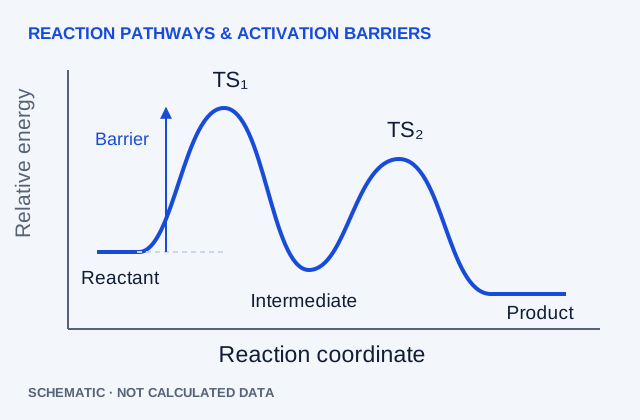
A reaction mechanism connects reactants, intermediates and products through elementary steps. Transition-state searches estimate the barriers between those states; competing pathways can have different energetic and structural requirements.
The Rh(211) mechanism study uses transition-state methods, including climbing-image nudged elastic band and dimer calculations, to investigate carbon-chain growth. Vibrational and thermodynamic corrections help connect electronic energies with the conditions represented in a model.
A barrier belongs to a particular step and starting state. A lower barrier in isolation does not establish which route dominates a reacting surface.
FROM ENERGETICS TO BEHAVIOR
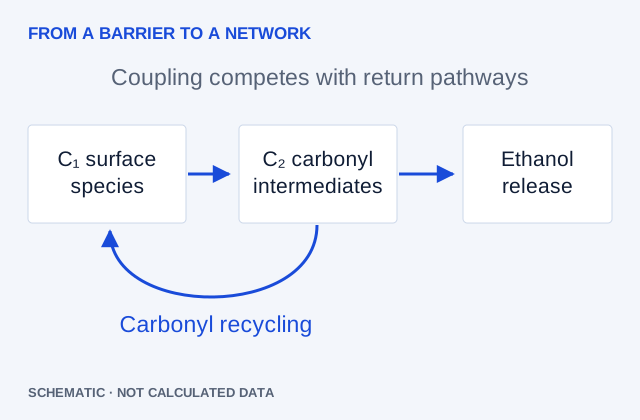
A microkinetic model assembles elementary reactions into rate equations, together with surface-site balances. Its solution predicts surface coverages and rates under the chosen assumptions; activity and selectivity are network-level outputs.
The Rh(211) preprint uses a first-principles mean-field model with flux and degree-of-rate-control analyses to examine carbonyl recycling and ethanol formation. Sensitivity analysis asks which elementary steps exert control within that model.
DFT supplies energetic information; the kinetic model predicts rates. Rate expressions, thermochemical corrections, consistency constraints and operating conditions connect the two.
COMPUTATIONAL CASE STUDIES
Three examples show how the computational question changes with the material and reaction. Each illustration is a schematic, not a reproduced calculation.
Comparing adsorption and electronic structure reveals how subsurface composition changes the environment of carbon on nickel.
Explore surface catalysis →Elementary reaction energetics become inputs to a network model that tests productive pathways against recycling.
Explore syngas conversion →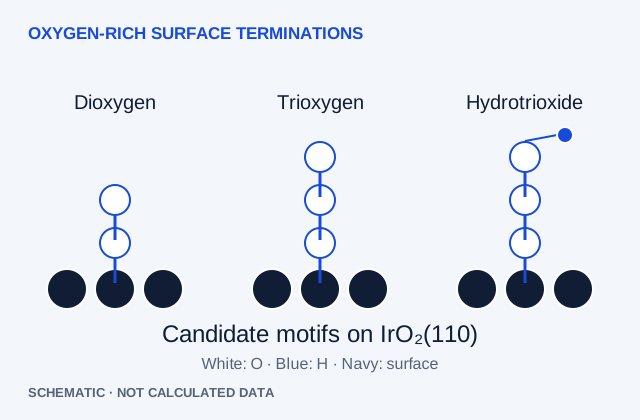
Potential-dependent thermodynamic comparisons identify plausible IrO₂ terminations for mechanistic analysis.
Explore electrocatalysis →METHODS & SCIENTIFIC APPROACH
METHODS & RESEARCH CAPABILITIES
Periodic DFT; adsorption energies and structures; electronic-state and bonding analysis.
Low-index and stepped slabs; alloy and subsurface modifications; adsorbates and defects.
Elementary reaction energetics; transition-state searches; mean-field microkinetics, reaction flux and degree-of-rate-control analysis.
Potential- and pH-dependent free energies; surface Pourbaix analysis; comparisons of terminations and hydrogen-containing surfaces.
SELECTED PUBLICATIONS
Scientific Reports 7, 13963 (2017). DOI: 10.1038/s41598-017-14050-3
Catalysis Letters 154, 3418–3425 (2024). DOI: 10.1007/s10562-023-04565-y
ChemRxiv, version 1 (2026). DOI: 10.26434/chemrxiv.15008804/v1
ACS Omega 11, 4692–4698 (2026). DOI: 10.1021/acsomega.5c10410
International Journal of Hydrogen Energy 61, 460–472 (2024). DOI: 10.1016/j.ijhydene.2024.02.248
RESEARCH COLLABORATIONS
These methods can support joint work on catalyst mechanisms, surface stability and structure–property relationships. I welcome projects in which computation and experiment sharpen the same scientific question.